
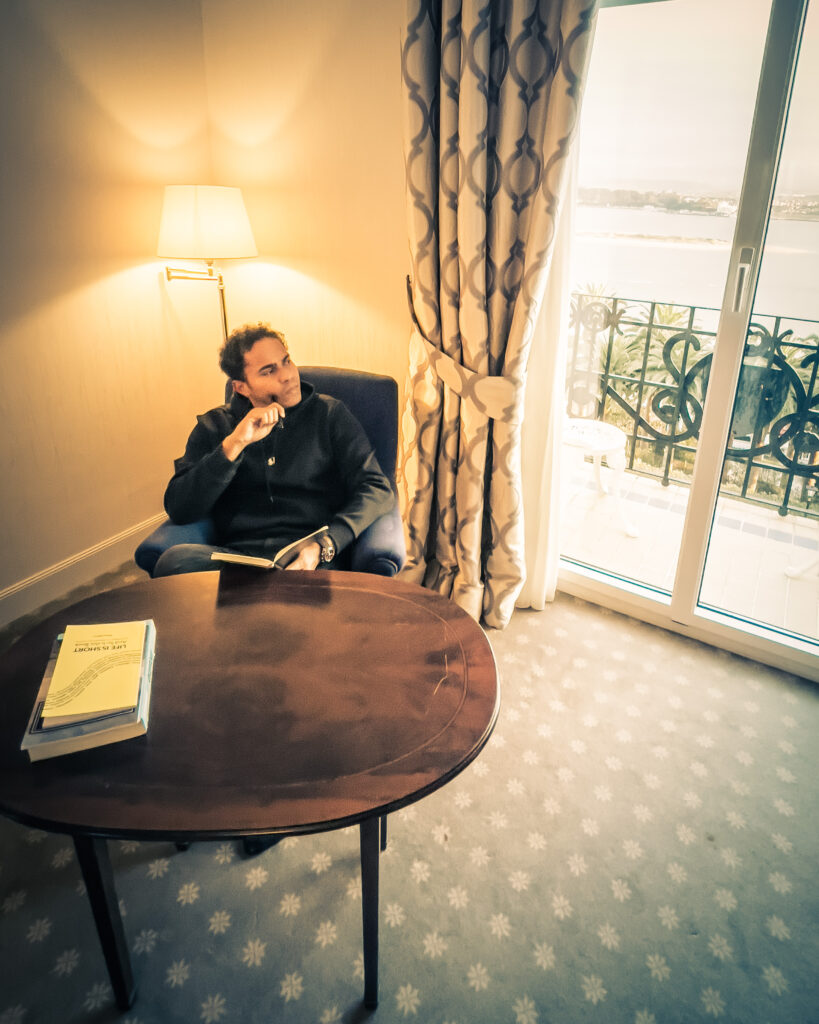
After 15 years of coaching, therapy, masterminds, and high-level mentoring, these are the principles that actually changed everything.
Here’s something I believe deeply: if you’re going to coach, consult, or guide other people through transformation, you’d better be doing the work on yourself too.
Over the past 15 years, I’ve invested over 1,500 hours and roughly $135,000 in my own personal development—coaching sessions, elite masterminds, therapy, mentoring, retreats, and countless hours of deliberate introspection. And I’m still investing.
What I’m about to share isn’t theory. These are the principles that created the most breakthroughs, the deepest shifts, the moments where everything suddenly clicked into place. Some people call them “quantum leaps.” I just call them the moments when something finally lands.
A quick disclaimer: I’m sharing the distilled version here. Each of these principles runs deep, and applying them to your unique situation is where the real transformation happens. But even as a synthesis, I’ve seen these ideas change the trajectory of people’s lives.
Let’s dive in.
Stop Digging and Learn to Live With Your Wounds
Personal development has a shadow side that nobody talks about enough.
If you’re someone who values growth (and if you’re reading this, you probably are), it’s easy to fall into what I call the endless excavation trap—going from one problem to the next, one trauma to the next, constantly digging without ever climbing out of the hole.
Here’s the uncomfortable truth: not everything will be resolved. Some wounds won’t fully heal. Some questions won’t get neat answers. And that’s okay.
The real skill isn’t fixing everything. It’s learning to carry your scars without letting them poison your life or your relationships. It’s the difference between productive introspection and compulsive self-analysis that keeps you stuck in an identity built around brokenness.
There’s a fine line between doing meaningful inner work and endlessly circling the same pain. Knowing when to stop digging and start building is one of the most underrated personal development skills you can develop.
The Right Questions Will Free You More Than Any Answer
This one frustrated me for years.
I traveled across continents looking for answers. I sat with mentors, coaches, and therapists in different countries and cultures. And every single time, instead of giving me the answers I was looking for, the best ones asked me better questions.
It took me a while to understand: the questions were the point.
The right question, asked at the right time, can unlock something that years of conventional searching never will. The best coaches and mentors I’ve worked with didn’t give me their framework to follow—they asked questions that helped me find my own answers.
I’ve since turned this into a daily practice through journaling and guided introspection. Directed, intentional questioning has unlocked more for me than any course, book, or seminar ever did.
If you take one thing from this article, let it be this: stop chasing answers. Start asking better questions.
External Noise Drowns Out Your Internal Compass
Other people’s opinions. Social pressure. The comparison game on social media. The “you should be doing this by now” narrative that follows us from every direction.
All of it creates noise. And that noise makes it nearly impossible to hear your own voice.
We live in an era of constant input. Algorithms feed us other people’s highlight reels. Industry “experts” tell us the one strategy we absolutely need to follow. Friends and family project their own fears and limitations onto our decisions.
Cutting through this noise isn’t optional—it’s essential.
Taking time for yourself, getting quiet, asking yourself the hard questions (and actually listening to the answers) is not a luxury. It’s the foundation of every good decision you’ll ever make.
And here’s what I’ve found after 15 years: the better you know yourself, the more grounded and resilient you become when the storms hit. Self-knowledge is the ultimate anchor. It’s also a lifelong process—you never “arrive,” and that’s part of what makes it so powerful.
Your Inner Child Is Both Your Greatest Saboteur and Your Wisest Guide
That younger version of you—the one who still carries old insecurities, old fears, old stories about not being enough—can hijack your decisions at any moment. We’ve all experienced it: reacting disproportionately to criticism, avoiding risks because of a wound that hasn’t fully healed, self-sabotaging right when things start going well.
But here’s the other side of that coin: your inner child is also your most honest compass.
When I listen to what that part of me actually wants—not the fears, but the genuine excitement, the pure curiosity, the instinct toward joy—I consistently make better decisions. That childlike part of us knows what lights us up. It hasn’t been conditioned out of its instincts yet.
The work isn’t silencing your inner child. It’s learning to distinguish between its fears (which need reassurance) and its wisdom (which needs to be followed).
There Is No “Best Model”—Except the One Built From You
We’re constantly bombarded with “the best strategy,” “the proven framework,” “the system that generated $X in Y days.” And the seductive part is that these strategies often did work—for someone else, in their specific context, with their specific wiring.
But what works for others isn’t necessarily right for you.
This is why I never connected with coaches or mentors who tried to force me into their model. The ones who actually transformed my life were the ones who got curious about who I am, how I function, and then designed something with me—not for me.
I carry this same philosophy into my own work. I’m far more interested in understanding someone’s unique operating system than in imposing a one-size-fits-all framework.
The best model starts with you. Test things. Experiment. Keep what works, discard what doesn’t. And always listen to the people who are genuinely interested in understanding you—not the ones asking you to over-adapt to their vision.
This applies to everything: your business strategy, your organizational system, your career path, your daily routine.
The Most Effective Response to Anxiety and Fear
For a long time, I lived with a brain that wouldn’t stop spinning catastrophic scenarios. Worst-case futures playing on repeat—none of which ever actually happened.
Two practices changed this for me more than anything else:
Coming back to the present moment. Breathing exercises, meditation, grounding techniques. Not as a spiritual luxury, but as a practical tool for interrupting the anxiety spiral.
Learning real detachment. Not suppression, not avoidance—actual letting go. Understanding that most of what we worry about is a projection, not a prediction.
There may be deeper root causes worth exploring over the long term. But you can dramatically reduce the daily weight of anxiety by learning to recenter yourself and focus exclusively on what you can actually control.
Stop ruminating. Act. Move forward. Refocus. Let go.
These aren’t just nice-sounding platitudes. They’re survival skills for anyone building something meaningful in an uncertain world.
Nobody Is Watching You as Closely as You Think
So many of my fears—fear of failure, fear of being judged, fear of being seen as a fraud—ultimately traced back to one thing: the imagined gaze of others.
Here’s the liberating truth that changed everything:
The spotlight effect is a well-documented cognitive bias. We massively overestimate how much other people think about us and how much they care about our failures. The reality? Everyone is too busy worrying about their own image, their own mistakes, their own perceived shortcomings.
Nobody is judging you as harshly as you judge yourself. That audience of critics in your head? They don’t exist. Not like that.
You cannot imagine the potential you unlock when you stop living inside the prison of other people’s perceived opinions. It’s one of the most immediate and tangible upgrades you can make to your life.
Changing Your Beliefs Changes Your Reality
The single most powerful lever I’ve discovered in 15 years of personal development is pattern interruption—breaking habitual thought patterns that keep you locked in the same reality.
This is why elite masterminds and advanced mentors are so effective. Not because they give you better tactics, but because they expose you to ways of thinking you literally cannot access on your own. You don’t know what you don’t know. You can’t see your own blind spots.
We all carry invisible limitations—about money, about time, about what’s possible, about our own worth. These beliefs aren’t just thoughts. They’re the operating system running your entire life.
Every genuine breakthrough I’ve experienced—every “quantum leap”—was ultimately a shift in how I think, not what I do. A new state of being, not a new strategy.
The Most Important Lesson of All
For years, I believed that progress meant doing more. More strategy. More organization. More discipline. More hustle.
The biggest lesson from 15 years and $135,000 of investment?
It’s not what you do that changes everything. It’s the inner clarity with which you do it.
Intention, energy, and mindset matter more than the action itself. The same strategy executed from a place of fear produces radically different results than the same strategy executed from a place of clarity and alignment.
Over time, I’ve learned to ask the real questions—not the surface-level tactical ones, but the ones that reveal what’s actually driving my decisions. I’ve learned to tell the difference between genuine intuition and ego. To hear fear without letting it steer. To recognize when I’m in flow versus when I’m running away from something I don’t want to face.
And above all, the principle I come back to more than any other:
Keep it simple. Keep it simple. Keep it simple.
The most transformative insights aren’t complex. The most effective systems aren’t complicated. The most fulfilled people I know have learned to strip away everything that doesn’t serve them and focus on what actually matters.
Where Do You Start?
If these principles resonate with you, here’s my honest advice: don’t try to apply all of them at once. Pick the one that hit hardest. The one that made you pause. Start there.
And if you’re a multipotentialite, a creative entrepreneur, or someone who’s tired of forcing yourself into frameworks that weren’t designed for how you actually think and work—know that building from who you are isn’t just possible. It’s the only approach that lasts.
The best investment you’ll ever make is in understanding yourself. Everything else flows from there.
Which of these principles resonated most with you? What’s the biggest lesson your own personal growth journey has taught you? I’d love to hear your thoughts in the comments.